MOTHER OF THE CHURCH
Who has heard of such a thing?
Who has seen such things?
Shall a land be born in one day?
Shall a nation be delivered in one moment?
Yet as soon as Zion was in labor
she delivered her children.
Isaiah 66, 8
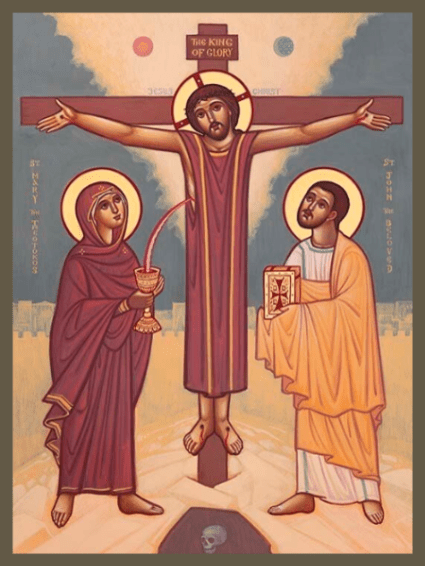
When Jesus therefore had seen his mother and the disciple standing, whom he loved,
he saith to his mother: Woman, behold thy son. After that, he saith to the disciple:
Behold thy mother. And from that hour, the disciple took her to his own.
John 19, 26-27 (DRB)
Catholic teaching on Mary, Mother of the Church, emphasizes her pivotal role in the redemption of humanity, particularly through her active participation in the suffering and passion of Jesus Christ. This teaching is deeply rooted in Scripture and Tradition. In particular, Mary’s presence at key moments, such as the Annunciation, where she willingly accepted God’s plan, and her standing at the foot of the cross during the crucifixion, highlights her profound involvement in the salvific work of Christ. Her sorrowful journey is illustrated by Simeon’s prophecy that a sword will pierce her soul (Luke 2:35), underscoring the depth of her suffering as she witnesses her Son’s sacrifice. Mary’s unwavering commitment and deep faith not only illustrate her unique relationship with Christ but also position her as a model for all believers. Through her grace-filled acceptance of her divine mission, Mary exemplifies how human cooperation with the divine will can lead to our redemption. This rich theological understanding of Mary’s experience underscores her vital and intercessory role in the life of the Church and the spiritual journey of all Christians.
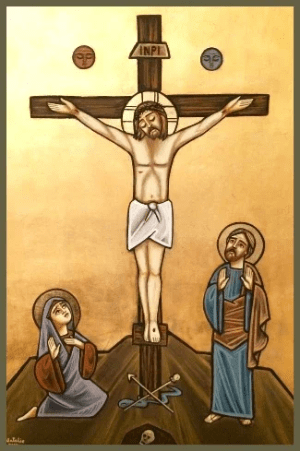
This profound truth is powerfully illustrated in her unwavering presence at the foot of the cross during the Crucifixion, where she experienced overwhelming sorrow as she witnessed the agonizing death of her Son. In that harrowing moment, Mary embodies the archetype of suffering, demonstrating empathy and the depths of maternal anguish. Her acceptance of this suffering and her vibrant faith exemplify her commitment to God’s salvific plan for humanity. By enduring this sorrow, Mary not only shares in the Passion of Christ but also aligns her own suffering with his, ultimately cooperating in the divine mystery of redemption and making temporal satisfaction for the world’s sins.
In Catholic theology, while it is firmly established that Jesus Christ is the sole Redeemer of humanity, Mary holds a unique and honored position as co-Redemptrix (“Mother with the Redeemer”). This title reflects her profound cooperation with God’s salvific plan and her active, albeit subordinate, participation in Jesus’s redemptive mission. From the moment of her Annunciation, when she consented to become the Mother of God, Mary exemplified unwavering faith and obedience to God’s will. Her acceptance of this divine vocation brought with it immense suffering, notably as she witnessed the passion and crucifixion of her son, Jesus. The Church teaches that her sorrows and trials represent a deep emotional and spiritual sharing in Christ’s sacrifice, thus allowing her to contribute to the mystery of redemption in a unique way.
In 1964, during the Second Vatican Council, Pope Paul VI officially proclaimed Mary the “Mother of the Church,” a title that underscores her maternal relationship to Jesus Christ and her integral role in the Christian community. This proclamation was not merely ceremonial; it reflected a deeper theological understanding that recognizes the Church as the mystical body of Christ, with Mary as its spiritual mother. Throughout history, the Virgin Mary has been a symbol of compassion and suffering, and her own trials—such as the anguish she experienced at the crucifixion of her Son—have profoundly connected her to the Church’s suffering throughout the ages. This connection underscores Mary’s empathy and intercessory power, highlighting her importance to believers’ spiritual lives as they navigate their own struggles and challenges within the faith.
Thus, the teaching of Mary, Mother of the Church, reflects the understanding that her participation in the suffering of Christ parallels and complements His redemptive work. Through her sorrows at the foot of the cross, Mary spiritually gave birth to redeemed humanity, thereby demonstrating that, through suffering, one can attain greater intimacy with Christ and a deeper understanding of God’s love. Through Mary’s example, the Catholic Church teaches the importance of embracing both joy and sorrow in the life of faith, ultimately leading to redemption and hope.
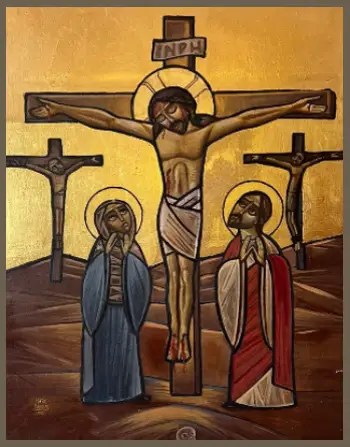
In a biblical context, redefined Mary’s motherhood while on the Cross. Rather than severing his bond with her, he enriched her maternal role within the framework of salvation. Notably, Jesus entrusted Mary to the Disciple at this pivotal moment in salvation history, underscoring the importance of her role. The redefinition of Mary’s motherhood at the Cross is rooted in her deep connection to her Son and his mission of redemption, as highlighted in Luke 2:34-35. By sharing in her Son’s suffering, Mary is likened to a woman in labor, contributing to the spiritual rebirth of humanity and offering grace to all descendants of Eve (Jer 4:31; Isa 60:20-21; Rev 12:1-5, 17).
In Christian theology, the Evangelist uses the term “the disciple” as a symbolic reference to himself, representing all faithful followers of Christ. This concept is akin to Jacob, who symbolizes Israel, illustrating the idea of a “corporate personality.” Mary, recognized as the spiritual mother of all disciples, plays a vital role in this framework, having embraced all believers just as the Father has through our participation in divine life through faith, as noted in Ephesians 1:5 and 2 Peter 1:3-4. In the mystery of Christ’s nature, he is the Son of the Father in his divinity and the Son of Mary in his sacred humanity. Therefore, it is understood that one cannot claim to be an adopted son or daughter of the Father while disregarding the relationship with our spiritual mother, Mary, who conceived Jesus by the Holy Spirit. This belief is grounded in the understanding that all faithful individuals are true brothers and sisters of Christ (Rom 8:29).
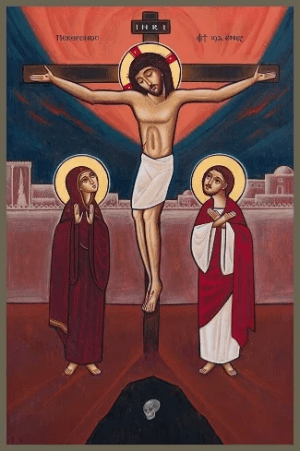
According to 2 Corinthians 5:17, those who are baptized are transformed into “a new creation in Christ.” This transformation signifies a shift in identity from being descendants of Adam to being part of the lineage of the promised “Woman,” which refers to the mother of the divine Messiah (Gen 3:15). Mary is viewed as an advocate for Eve, who, in her innocence, contributed to the loss of grace for humanity by her actions. This introductory narrative underlines the importance of Mary in salvation history, as early Church Fathers, notably St. Augustine, emphasized her unique role. Augustine of Hippo taught that Mary is exceptional in being both the Mother and the Virgin of Christ, and that her cooperation through faith and charity enabled the spiritual birth of faithful Christians within the Church (De sancta virginitate 6). This belief reflects the early Church’s understanding of Mary’s significance in connection with salvation and grace.
Mary is recognized as the Mother of the Church, which encompasses all members of the mystical body of her divine Son, Jesus Christ. She serves as a prototype of the Church, bestowing upon it a unique character that reflects her own significance. In this context, the Church finds its fulfillment through the figure of Mary. Her role in the Church is vividly illustrated by her proclamation: “Be it done to me according to thy word” (Lk. 1:38). This declaration is foundational, as it marks the moment when the Church, represented by Mary, first begins its mission. The concept extends to the idea that for individuals to be spiritually born into the Church—symbolized by baptism—they must first welcome Jesus into their hearts. This spiritual conception mirrors Mary’s own experience, where she first accepts Christ in her heart before physically conceiving him. Mary embodies the Mother of the Church through the Incarnation. By conceiving and giving birth to Jesus, who is both the Head and the Body of the Church, Mary also spiritually nurtures and brings forth her Son’s brothers and sisters, believers who are incorporated into the Church through faith.
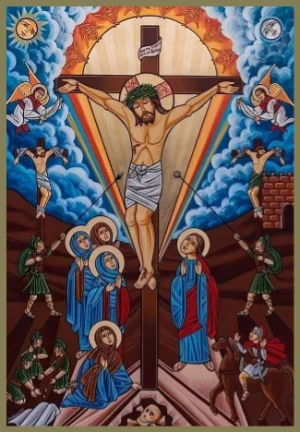
The imagery in the Gospel narrative suggests that Jesus’ address to his mother and the Disciple carries profound significance, particularly with respect to themes of salvation and the end times. John the Evangelist presents the Virgin Mary as a symbolic figure standing at the foot of the Cross, which is interpreted as the Tree of Victory over sin. This positioning underscores her role as a channel of grace from her divine Son. This concept of grace contrasts sharply with the biblical account of Adam, who forfeited it by yielding to Eve, thereby precipitating the fall of humanity and the loss of original holiness and justice. In contrast, Mary’s perfect obedience to God’s will and her willingness to bear suffering alongside her Son are portrayed as vital contributions to humanity’s spiritual regeneration and justification. Through her actions, Mary plays a crucial role in restoring the grace lost due to original sin.
The Gospel conveys that the Son, referred to as the new Adam, aims to dispense his saving grace primarily through his mother, who serves as a vital collaborator in his mission. This concept aligns with the notion presented in Genesis 2:18, emphasizing that our Lord prefers not to act alone in the work of redemption. Instead, he seeks his mother Mary’s moral cooperation. In this role, Mary is recognized as the spiritual mother of all disciples and redeemed humanity. She has supported the faithful by sharing the blessings of God’s grace, which she received through her willingness to endure sorrow for her Son during his Crucifixion, ultimately the foundation of salvation. Mary’s spiritual motherhood is significant because she played a crucial role in restoring fallen humanity to a life of grace with God, in contrast to Eve, whose actions led to humanity’s downfall through disobedience and the pursuit of personal gain.
In biblical interpretation, Jesus refers to his mother, Mary, as “Woman,” a designation that is significant because it associates her with the figure of the new Eve. This designation suggests that Mary serves as the spiritual mother of all humanity, in contrast to Eve, who is regarded as the primordial mother of all living beings. Unlike Eve, whose offspring are born without sanctifying grace and are spiritually dead (as noted in Genesis 3:20), Mary embodies a figure of grace and life. Additionally, in Genesis 2:23, Adam also addresses his wife as “Woman” prior to the Fall, indicating an original state of innocence and sanctity in their relationship. By using the title “Woman” for Mary, Jesus implies that she is to fulfill a maternal role for his disciples, reflecting the purpose intended for Eve before the fall from grace.
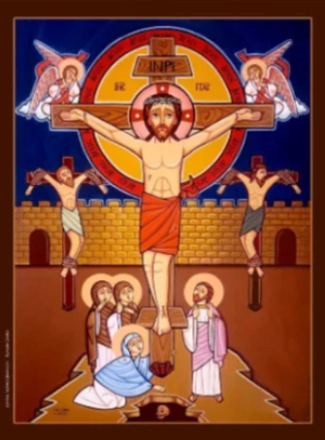
The narrative of Adam and Eve illustrates that had they not disobeyed God, they would have been able to transmit both spiritual and physical immortality to their descendants. However, following their transgression, these divine gifts were forfeited. To restore spiritual life to humanity, it is believed that God established a new pathway of spiritual continuity through the intimate union of a man, often referred to as the new Adam, and a woman, known as the new Eve. This sacred union is thought to reflect the original harmony that existed between Adam and Eve prior to the Fall.
The concept of the Tree of Life is symbolically represented by the Cross on Golgotha, in contrast to the tree in the Garden of Eden, which bears the forbidden fruit, as noted in Genesis 2:15-17. At the heart of the Cross hangs the fruit of Mary’s womb, as referenced in Luke 1:42. This fruit serves as a direct counter to the transgressions against God’s commands and the resulting consequences outlined in Genesis 3:16-20. In the narrative of Genesis, Eve persuades Adam to eat the forbidden fruit from the Tree of Knowledge of Good and Evil, leading to their fall. Conversely, Mary plays a pivotal role in cooperating with her Son, presenting to humanity the fruit of her womb—Jesus—who is cherished by the Father, as stated in Matthew 3:17. By embracing this divine fruit, mankind receives nourishment and strength through grace, which empowers them to escape the entrapments of secular wisdom and ephemeral pleasures. These distractions have the potential to jeopardize the soul’s well-being and obstruct true happiness in a life aligned with God.
The concept of access to the Tree of Life has evolved within Christian theology. Unlike the biblical account in which God guarded the Tree of Life with cherubim and a flaming sword, today’s believers regard the Church as the gateway to the Tree of Life and to the grace of salvation. According to Christian teachings, Jesus Christ, the Son of Mary, has achieved salvation for all humanity, and the Church welcomes anyone who seeks peace and reconciliation with God through the Cross. Several biblical passages support this understanding, including Isaiah 35:8, which speaks of a holy way; Isaiah 62:10-12, which emphasizes the restoration of the people; Acts 2:22, which highlights the miracles performed by Jesus; Colossians 1:20, which mentions reconciliation through Christ; and Revelation 22:17, offering an invitation to all who thirst for eternal life. As baptized Christians, we are encouraged to celebrate the graces bestowed by Jesus and mediated through his most blessed mother.
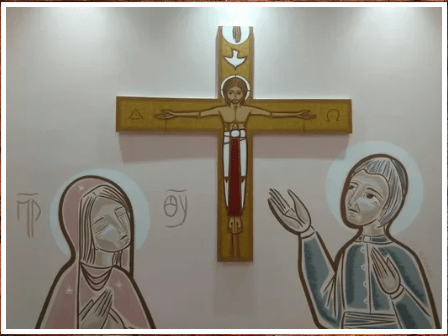
ἔλαβεν ὁ μαθητὴς αὐτὴν εἰς τὰ ἴδια.
In the Gospel of John, the phrase “the Disciple took her to his own” uses the Greek word “lambanō” (λαμβάνω), which means “to take in the hand” or “to grasp.” This term encompasses a range of meanings, including receiving, taking up, or removing without force. In addition to its physical implications, “lambanō” also has mental and spiritual dimensions. It can be interpreted as “making one’s own,” “apprehending,” or “comprehending,” a translation provided by Jerome in the Latin Vulgate. Renowned Roman Catholic biblical scholar John McHugh elaborates on this spiritual meaning, suggesting that the Disciple’s action signifies his acceptance of Mary not only as his mother but also as part of the “spiritual legacy” entrusted to him by Jesus. The use of the verb “lambanō” underscores a dimension that extends beyond the immediate context of the death scene at Golgotha, linking it to deeper spiritual themes.
The author says, “If we carefully notice John’s vocabulary, a more meaningful rendering emerges. In the Fourth Gospel, the verb lambánō has two senses. When applied to material things, it means simply ‘to take hold of,’ ‘to pick up,’ ‘to grasp,’ etc. (e.g. 6.11; 12.13; 13.12; 19.23, 40); when applied to immaterial things, it means “to accept,” or ‘to welcome,’ usually as a gift from God (e.g. his witness, 3.11; his word, 17.8; his Spirit, 14.17; 1 John 2.27). Secondly, the phrase eis ta idea, which certainly can mean “to one’s own home” (in a purely physical sense), can also mean ‘among one’s own spiritual possessions’ (compare John 8.44 and 15.19, in Greek). The phrase is found in the prologue with this double meaning of ‘physical home’ and ‘spiritual possession’ and in close conjunction with the verb ‘to accept or welcome.’ ‘He came to what was his own… and to all who accepted him, he gave them the power to become children of God’ (John 1.12-13). John 19.27 demands a translation that includes the purely physical and the deeper, spiritual sense” (The Mother of Jesus in the New Testament, New York: Doubleday, 1975). The use of the verb lambanō indicates something important that moves beyond the death scene being played out on Golgotha but is connected to it. Thus, the verb indicates something which has soteriological and eschatological significance.
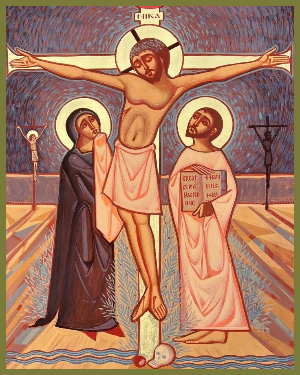
The Mother and the Beloved Disciple recognized that a significant event signified a new beginning—one that would continue in both this life and eternally in the Kingdom of Heaven. In examining the original Greek text, the phrase “to the own” (εἰς τὰ ἴδια) offers a deeper meaning than the translations found in modern Protestant and Catholic Bibles, which often render it as “to his own home.” This Greek phrase suggests that the Disciple did not merely take Mary into his physical abode; rather, it indicates a profound spiritual connection in which he embraced her as a loving son within their newly established bond.
In this context, the Disciple takes Mary into his heart and accepts her as a spiritual mother, signifying an intimate relationship at the core of his being. Furthermore, Mary did not need to be an adoptive mother for John to fulfill a caregiver role; instead, Jesus’ words highlight Mary’s spiritual significance. She became a mother to the Disciple within the family of God, both spiritually and mystically. This relationship mirrors Mary’s own connection to the Holy Spirit, as she was overshadowed by Him and participated in the divine act of begetting Jesus, our Lord and brother.
Shall not Zion say:
This man and that man is born in her,
and the Highest himself hath founded her?
Psalm 87, 5
EARLY SACRED TRADITION
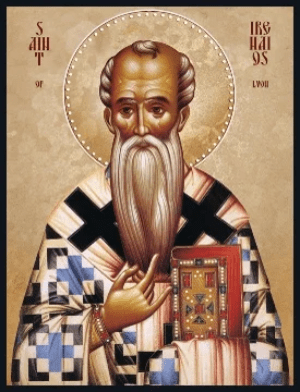
St. Irenaeus of Lyons
Against Heresies, 4, 33, 12
(A.D. 180-190)
“The Word will become flesh, and the Son of God, the son of man–
the Pure One opening purely that pure womb,
which generates men unto God.”
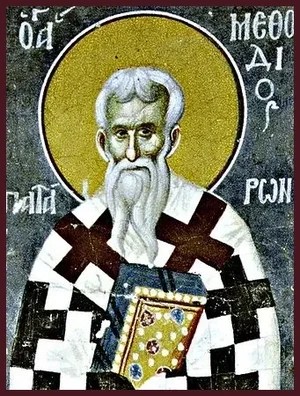
St. Methodius of Philippi
De sanguisusa 8, 2
(ante A.D. 311)
“It would be wrong to proclaim the Incarnation of the Son of God from the
holy Virgin, without admitting also His Incarnation in the Church. Every one
of us must therefore recognize His coming in the flesh, by the pure Virgin, but
at the same time recognize His coming in the spirit in each one of us.”
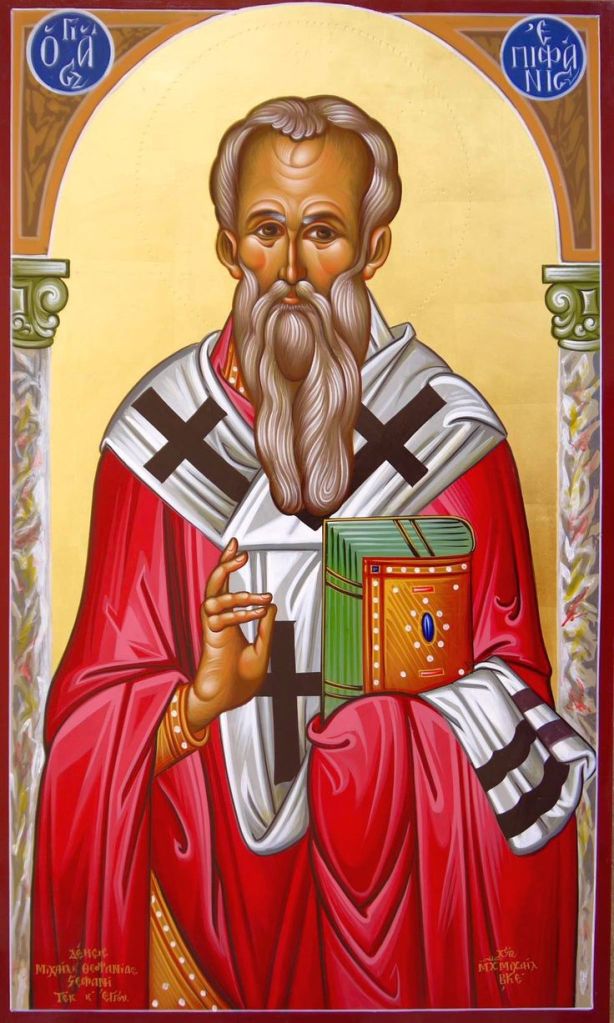
St. Epiphanius of Salamis
The Man Well-Anchored 75
(A.D. 374)
“Being perfect at the side of the Father and incarnate among us,
not in appearance but in truth, he [the Son] reshaped man to perfection
in himself from Mary the Mother of God through the Holy Spirit.”
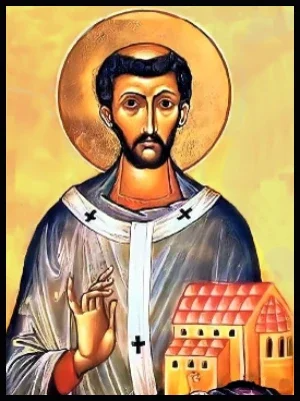
St. Augustine of Hippo, Tract 1, 8
(ante A.D. 430)
“The Church is a virgin. Perhaps you will say: If she is a virgin, how can she beget children?
Or, if she does not bear children, how can we claim to be born from her womb? My answer is:
She is both virgin and mother; she is like Mary who gave birth to the Lord. Was not Mary a virgin
when she gave birth, and did she not ever remain a virgin? But the Church also gives birth and yet
remains a virgin she gives birth to Christ Himself, for all who receive baptism are His members.
Does not the Apostle say: ‘You are the body of Christ, member for member’? If then she gives
birth to Christ’s members, she is in every way like Mary.”

AVE MARIA
 Blessed Above all Women
Leave a comment